What does cause heart attacks?
A study published in 2012 – reviewed 500,000 people who had suffered their first heart attack, and looked into the factors that predict heart-attack risk.
The number-one factor was weight: 79 percent of the group were
overweight.
Second, occurring in 72 percent of subjects, was normal blood-lipid
concentrations.
Third was hypertension.
Fourth was smoking.
Fifth was diabetes.
Of course,  cholesterol didn't feature, and in fact, not one of these causes can be linked to eating a high-fat diet. It can be easily argued that points one, two, three and five could be linked to a high-carbohydrate diet.
Abnormal Glucose Metabolism
At the European Society of Cardiology Congress 2004, Dr Lars of the Rydén Karolinska University Hospital, Solna, Sweden, said that abnormal glucose metabolism is common in acute heart-attack patients. "We know," he said, "that blood glucose increased to a level below the diagnostic target for diabetes increases the risk for mortality and cardiovascular disease."
The Heart Disease Mystery
Diets low in fat and cholesterol have failed dismally to demonstrate a causal link with coronary heart disease; abnormal glucose metabolism is a much stronger predictor of a future heart attack. And that points to "healthy eating" and a diet based on carbohydrates and unnatural polyunsaturated vegetable oils as more likely causal factors.
Coronary Artery Calcium Score
 A study from 2014, looked into the presence of calcium, which accumulates with the build-up of plaque, in the coronary arteries. By analysing your arteries and calculating how much calcium is present, we can tell how badly damaged the arteries are.
In this study, thousands of people's hearts were scanned and allocated a hazard ratio according to their risk of developing a heart attack. A hazard ratio of 1, up to level 5, was given to estimate risk of a heart attack. Those with the lowest coronary artery calcium score had the lowest hazard ratio.
Some people believe, that no measure in your body better predicts your future risk of heart attack than your coronary artery calcium volume score.
Clogged artery does not cause heart disease.
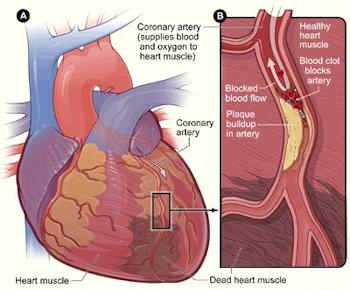 A clogged artery is normally safe because, as the artery closes up, the body responds to the problem by developing what are known as collateral arteries that take blood past the obstruction.
What kills you is a sudden rupturing of plaque caused by inflammation in an area of a blood vessel that has narrowed, which causes a blood clot to occur, and where there is no collateral blood supply. The inflammation and rupture are the critical causes of a heart attack.
Higher Risk in Older Women
Low-fat, high-carbohydrate diets [15% protein, 60% carbohydrate, 25% fat] increase the risk of heart disease in post-menopausal women."
The Woman's Health Initiative, was started in 1993, enrolling 49000 women; with the objective of proving once and for all, the great value of a low-fat diet.
The women were encouraged to eat more fruit and vegetables and whole grains. They were to eat less meat (chicken preferred) and avoid excessive fat.
Over 9 years the women reduced their fat intake from 37% to 29% of calories. They were successful in reducing the amount of saturated fat they ate. And they did lose weight, on average a tiny 1 pound each.
Results: Women in the study failed to lose as much weight as expected.
There was no significant reduction in the risk of either heart disease or cancer.
This was the Rolls Royce of studies, and the researchers looked at their results in disbelief. Tim Byers, one of the principle researchers said, "Everyone already knew that eating a lot of fruits and vegetables and cutting back on fat constituted a healthy diet. (So) We are scratching our heads over some of these results." He could not bring himself to say that the "final word" is this: low-fat diets don't work as expected.
In 1992, Dr William Castelli, who had been a director of the Framingham Heart Study, admitted the failure of the low-fat and low cholesterol diet. "We found that the people who ate the most cholesterol, ate the most saturated fat, and ate the most calories, weighed the least and were the most physically active."
Heart Disease in Diabetics
Dysglycemia is a malfunction in the way the body deals with glucose in the blood. It's well recognised as a factor leading to type 2 diabetes.
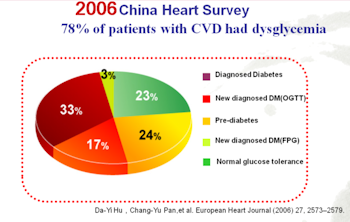 In general, study has demonstrated that multiple risk factors for coronary heart disease are worsened for diabetics who consume the low-fat, high-carbohydrate diet so often recommended to reduce these risks. This is because high levels of glucose in the blood over a long period of time "glycosylate" haemoglobin. (Glucose molecules become attached to the red blood cells.)
This glycosylation was found to increase the risk of a heart attack in both diabetics and non-diabetics in a 2005 study by scientists at Johns Hopkins University. In this study, non-diabetics risk was more than doubled. Once again the message is reduce your intake of carbohydrates, to protect against heart disease.
Higher Risk in the Elderly
All our cells rely on a constant and sufficient supply of cholesterol. Still, advice today, is aimed at lowering cholesterol levels in people of all ages, but these facts together suggest that drug or dietary regimes aimed at lowering cholesterol in people aged over seventy might well shorten their lives.
By 1980, it was obvious that the predictive value of total cholesterol was weak. The Framingham Study was intended to produce the most conclusive evidence. The study began in 1948. By 1978, after 30 years this was the result.
Effect of Total Cholesterol on Heart Disease
| Men and Women |
205-264 mg/dL |
|
No relationship |
| Men |
Less than 220 mg/dL |
|
Increased risk |
| Men |
Mid-range mg/dL |
|
Increased risk |
| Men |
Greater than 220 mg/dL |
|
Decreased risk |
So that's a total failure to prove that high total cholesterol causes heart attacks. More-over the evidence shows that at least for older men high total cholesterol might be protective.
Printed from, http://www.openfuture.biz/cardio-vascular-disease/Heart-Disease-ph.html