
 Printable page in A4 size
 President Eisenhower's Heart Attacks
The 34th President of the USA, President Eisenhower suffered his first heart attack in 1955. The most eminent heart specialist in the USA was assigned to his care, Dr Paul Dudley White.
 Prof. Ancel Keys, of the University of Minnesota, took the opportunity to tell the nation that everybody should be eating a low-fat, low-cholesterol diet. Cholesterol was part of the hardened deposits (plaques) in the artery walls of people with atherosclerosis. Since animal fats, particularly saturated fats contained cholesterol, Keys connected the dots without any experimental evidence to back his assertions. Dr White collaborated with Ancel Keys in developing the diet-heart hypothesis, and authored the Foreword to Ancel Keys's 1959 book "Eat Well and Stay Well".
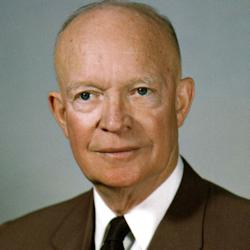 Eisenhower was a heavy smoker, of normal weight, with normal total cholesterol. In that time, smoking was very common and was not seen as a possible problem.
Eisenhower was advised to eat fewer saturated fats and limit dietary cholesterol. He was also advised to ride a push-bike. He did exactly as he was told, but his weight increased, and his total cholesterol went up. A military man who prided himself on self-discipline, Eisenhower tried to do better. Once again, the result was worse.
Eisenhower completed two terms as President (1953-1961). However there were 6 more heart attacks.
Eisenhower also suffered persistent problems with his digestive system.
He died in 1969 of a heart attack (Aged 78).
By this time, the research community thought they understood what caused heart attacks and how to lessen the risk. They thought that people needed to make several changes in lifestyle, to reduce the incidence of heart disease. You will be familiar with these. They are still commonly recommended. The 1970's version of a "heart safe" programme was a Low-fat diet, more exercise, blood pressure control, to cease smoking, and reduce total cholesterol. The study of this programme was called The Multiple Risk Factor Intervention Trial. Before you click that link, ask yourself how that trial turned out?
Originally funded from 1973 to 1982. The MR-FIT trial closed early. It was a very big trial: Evaluated 361,000 middle aged men from 28 medical centers. $115 million investment. This was a effort to hit all of the FOUR things they were certain caused heart disease.
At the same time, another group began a study to see if lowering total cholesterol with a drug,"cholestyramine" was effective when combined with a low-fat diet. The result was positive, but insignificantly so. Dr Philip Handler chairperson of the Food and Nutrition Board in 1980 said, "However tenuous the linkage, and however disappointing the various intervention trials, it seemed prudent to propose ..." He goes on to confirm acceptance of the low-fat diet and reduced cholesterol recommendation. He concludes his statement saying, "Resolution of this dilemma turns on a value judgment. The dilemma posed is not a scientific question; it is a question of ethics, morals and politics. Those who argue either position strongly, are expressing their values; they are not making scientific judgments."
For the next thirty years that was the basis for public policy on the recommended diet, and how to reduce the risk of heart disease.



